
The BC Budget 2026 introduces several important tax changes that directly affect small businesses across British Columbia. From expanded PST on professional services (effective October 1, 2026) to a new refundable manufacturing tax credit and a permanent BC SR&ED program, business owners need to understand how these updates impact cash flow, investment decisions, and personal tax planning.
Below is a breakdown of the most relevant BC small business tax changes for 2026.
PST Expansion on Professional Services (Effective October 1, 2026)
One of the most significant changes in the 2026 BC Budget is the expansion of Provincial Sales Tax (PST) to certain professional services.
Effective October 1, 2026, PST will apply to services including:
- Accounting and bookkeeping
- Engineering and architectural services
- Commercial real estate servicesSecurity and investigative services
- Security and investigative services
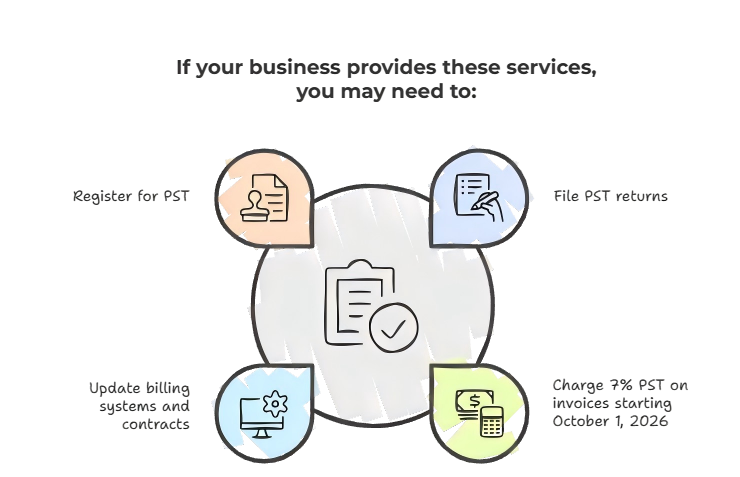
If your business purchases these services, invoices dated on or after October 1, 2026 will include 7% PST. Unlike GST, PST is generally not recoverable as an input tax credit, meaning this is a direct increase in operating costs.
Most small businesses in British Columbia use at least one of these services. Beginning in Q4 2026, this change will quietly increase overhead across many industries.
Businesses should begin preparing systems and pricing adjustments well before October 1, 2026.
BC Manufacturing & Processing Investment Tax Credit (2026–2031)
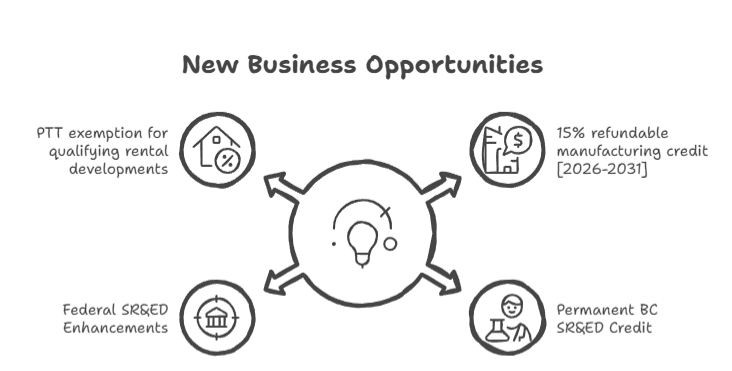
BC introduced a 15% refundable Manufacturing and Processing (M&P) Investment Tax Credit under Budget 2026.
Timeline:
- Applies to eligible property acquired after April 1, 2026
- Available until March 31, 2031
The credit applies to qualifying machinery, equipment, and certain buildings used in manufacturing or processing.
Because it is refundable, corporations can receive a cash refund even if taxable income is low.
Example: $100,000 Equipment Purchase
Assume your CCPC purchases $100,000 of qualifying equipment.
BC M&P Credit (15%)
$100,000 × 15% = $15,000 refundable credit
Assume full first-year accelerated CCA remains available federally.
Corporate Tax Savings (11% BC small business rate)
$100,000 × 11% = $11,000 tax savings
Total Year-One Benefit:
- $15,000 refundable BC credit
- $11,000 corporate tax savings
= $26,000 total benefit
Effective after-tax cost in year one: approximately $74,000.
For manufacturers and processing businesses in BC, this is one of the most meaningful cash-flow incentives introduced in BC Budget 2026.
Planning Opportunity for 2026–2031
If you are considering purchasing equipment, expanding production, or scaling operations over the next five years, timing matters.
At Purpose CPA, we help BC small businesses model capital purchases, optimize refundable tax credits, and plan investment timing strategically. A short planning discussion with us before committing to major equipment purchases can significantly improve cash flow.
BC SR&ED Tax Credit Is Now Permanent
The BC SR&ED tax credit has been made permanent under Budget 2026.
The provincial program now aligns more closely with recent federal SR&ED updates, including:
- Reintroduction of capital expenditures
- Increased federal expenditure limits
- Greater coordination between federal and provincial claims
BC continues to provide:
- 10% refundable credit for eligible CCPCs
- 10% non-refundable credit for other corporations
Example: $100,000 Labour + $100,000 Equipment
Assume:
- $100,000 eligible R&D labour
- $100,000 eligible R&D equipment
Total qualifying expenditures: $200,000
Federal SR&ED (35% refundable for qualifying CCPC):
$200,000 × 35% = $70,000 refundable credit
BC SR&ED (10%):
$200,000 × 10% = $20,000 refundable credit
Total Combined Refundable Credits:
- $70,000 federal
- $20,000 BC
= $90,000 refundable credits
Net after-credit cost: approximately $110,000, before considering additional deductions.
For innovative small businesses in British Columbia, the combined federal and BC SR&ED credits remain one of the strongest tax incentives available.
Personal Income Tax Changes in BC (2026)
BC Budget 2026 increases the lowest provincial personal income tax rate from 5.06% to 5.60%.
The province is also pausing indexation of tax brackets, increasing long-term bracket creep exposure.
Example: Paying Yourself $100,000
The rate increase applies only to income within the first provincial bracket (approximately $47,000).
Rate increase:
5.60% – 5.06% = 0.54%
Additional tax:
$47,000 × 0.54% ≈ $254 per year
On $100,000 of personal income, the immediate impact of the rate change alone is approximately $250 annually, with additional long-term impact from bracket freeze effects.
Compensation strategies should be reviewed heading into 2026.
Children and Youth Disability Supplement
BC Budget 2026 introduces the Children and Youth Disability Supplement.
The supplement provides up to $6,000 annually per eligible dependent, paid monthly alongside the BC Family Benefit.
Key details:
- Reduced at 4% once family income exceeds $50,000
- Fully phased out at $200,000 of family income
- Payments begin July 1, 2027
Families with eligible dependents should project household income to estimate benefit amounts.
Speculation and Vacancy Tax Increase
The speculation and vacancy tax rate increases to 4% for foreign owners and untaxed worldwide earners.
If residential property in designated BC regions is vacant or does not meet residency requirements, tax exposure increases under Budget 2026.
Holding companies and corporate real estate structures should be reviewed to assess potential impact.
Property Transfer Tax (PTT) Update
General Property Transfer Tax rates remain unchanged.
However, certain newly constructed purpose-built rental buildings will now qualify for an exemption under the purpose-built rental exemption.
For developers and investors in multi-unit residential rental housing in British Columbia, this exemption can significantly reduce acquisition costs.
What BC Small Businesses Should Do Now
BC Budget 2026 increases costs in some areas while strengthening targeted incentives in others.
Increased Costs:
- Non-recoverable PST on professional services (starting October 1, 2026)
- Modest personal income tax increase
The businesses that benefit most will be those that plan ahead — particularly before October 1, 2026 and before major capital investments.
Final Thoughts on BC Budget 2026 for Small Businesses
The 2026 British Columbia Budget broadens the provincial tax base while maintaining strong incentives for manufacturing and innovation.
For small business owners in BC, proactive planning will determine whether these changes increase pressure or create opportunity.
If you are considering equipment purchases, SR&ED claims, compensation adjustments, or real estate restructuring, now is the time to model the impact.
At Purpose CPA, we help British Columbia entrepreneurs turn tax changes into strategic advantages. If you want clarity on how BC Budget 2026 affects your business specifically, book a consultation with our team today!